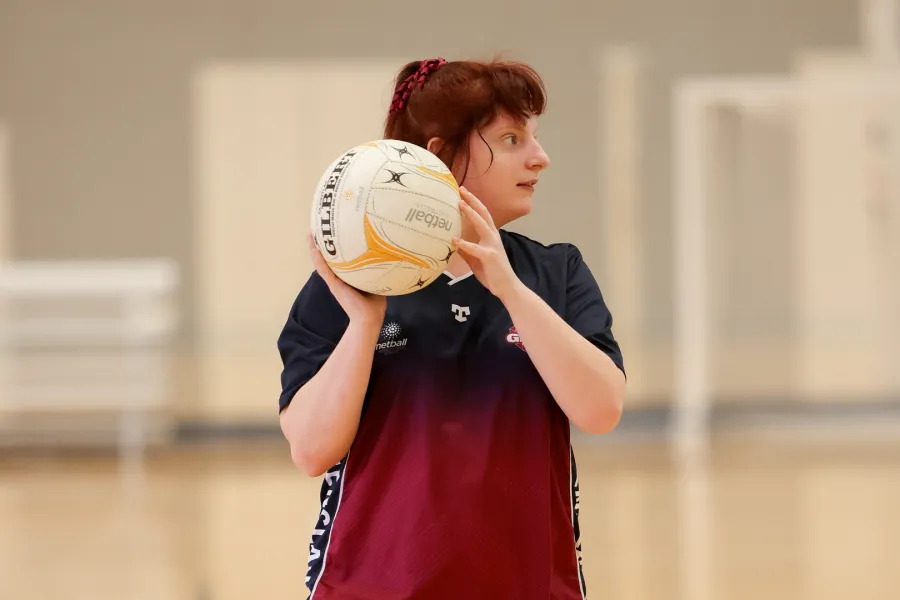
By Stephanie Smarrelli
Ask Olivia Page what she loves most about netball, and the answer comes without hesitation.
"The social interaction and the thrill of running and being part of something amazing," she said.
It's an answer shaped by years of perseverance.
Growing up with epilepsy meant playing sport wasn't always possible, but today the 20-year-old is doing far more than playing.
As captain of the Queensland Gems side in 2026, she's representing her state, cheering on her teammates and proving that belonging can be just as powerful as winning.
Set to compete at her fifth Marie Little Shield, pulling on the maroon uniform is something she never takes for granted.
“It's so rewarding, I love it and anybody in the world could have been put on that team, but they chose me,” she said.
Olivia's challenges began early in life.
She started having seizures as a baby before being diagnosed with epilepsy and an intellectual disability.
By the time she was three and a half, sunlight had become one of her biggest seizure triggers, meaning everyday childhood activities needed to be carefully managed.
Her mum Krischelle remembers how difficult those early years were.
"It was a lot to manage because Olivia also has an identical twin sister who also plays netball and has the same disability,” Krischelle said.
“Between the two of them they would have seizures and they were having over 130 seizures a day from the ages of three to about five.
The Queensland Gems leadership group received their dresses ahead of the 2026 Marie Little Shield.
"Living in Queensland, keeping them out of the sun was a huge challenge.”
Despite those challenges, Krischelle was determined to dig deep and ensure her daughters lived life as fully as they could.
“Each day I’d wake up and go ‘Alright, let’s do this all again and see how we go,’ and I would try and find solutions so they could live as normal a life as possible,” she said.
For years playing sport simply wasn’t an option.
But everything changed when Olivia became seizure-free more than six years ago.
Knowing she could finally give netball a try, family friends Susan and Gareth Osmond invited her to join the NetAbility program they run at Metropolitan Districts Netball Association in Brisbane.
“As soon as they heard Olivia was seizure-free they really wanted her to come and try it out,” Krischelle said.
With a few friends already playing netball, Olivia didn’t need much convincing.
Even then, life still required some adjustments.
“Going outside was tough at first,” Olivia said.
"We had to wear special sunglasses to help us with the sun. If we wanted to play with our friends outside, we couldn't go out unless we had a hat and sunglasses on."
“And we mostly played outside during the nighttime.”
Today, the sun is no longer an issue for Olivia, but she still manages her epilepsy with a few precautions in her daily life.
“I take medication so I can keep my seizures stable, and I limit activities like swimming," she said.
As captain of the Queensland Gems, one of Olivia’s favourite roles is helping other teammates feel confident.
“I love encouraging people and I enjoy being captain,” she said.
Krischelle also commended her daughter for the way she gets around the younger players and encourages them not to get too nervous.
Nerves were something Olivia battled herself when she first joined the team.
While Olivia has flourished through sport, Krischelle believes there is still more work to do in raising awareness of athletes with disabilities.
"There’s people with all different abilities that some people may not have heard of before,” she said.
“We have a lot of awareness of our elite players but many of the girls on the Queensland Gems team also have a physical disability on top of their intellectual one and that takes a lot of stamina.
“It takes a lot of pushing through and I don't think people are aware of that.
“I don’t say that to diminish the players who are experts in their field but as a parent and a spectator of the Marie Little Shield it’s so humbling to watch these players knowing what they go through just to be able to step on the court.”
With this year’s Marie Little Shield set to take place between 4 to 6 September in Melbourne, Krischelle has one clear message for the netball community.
“If you want to see pure joy you need to come and watch the Marie Little Shield,” she said.
For Olivia, she hopes her story inspires others living with a disability to embrace playing sport.
“Don't let your disability stop you,” she said.
“Don't think you can't do it, that's just your head saying you're not going to be able to do this, or no one will like you because of your disability but that's just noise.
“Block that out because you can do anything if you set your heart and mind to it.”