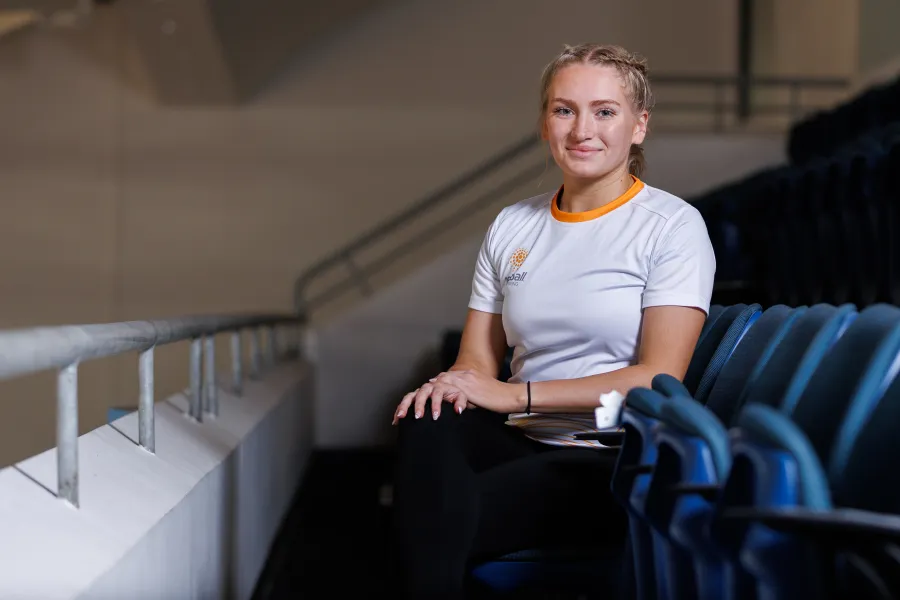
By Sophie Taylor
“It was the peak of my netball experience.”
High praise from Mackayla Harrison, the 2025 Marjorie Kerslake Umpire Awardee off the back of an outstanding debut at the First Nations Tournament last year.
The 20-year-old Kokatha woman credits netball for staying so connected to her community.
She was just 10 years old when she picked up a whistle for the first time.
“Netball's always been a big thing in my family,” she said.
“Dad and mum played, and they put me in netball as soon as I turned five.
“I'd be out at netball watching my sister and cousin, saw the umpires and loved the community.
“The umpire coordinator at the time said I had to be 13 but broke a few rules so I could umpire, she’d shadow me.
“I just loved having the ability to work towards something new.”
She would play one season with her sister and cousin before moving up a grade, ‘aging out’, before returning to their division the following season.
“A bunch of us Aboriginal netballers, we play together in summer, but then I'd age out and they would keep me around by umpiring and it was just the best thing ever,” Harrison explained.
“Being part of community, I guess that's why I started to really like it and then it started progressing into enjoying the feedback.”
From there, Harrison was invited into the Talent Identification pathway and driven by feedback and potential, her journey started to take flight.
“I had someone contact me and ask me to do state trainings, that I’d been identified as a really exciting umpire,” she said.
“I didn't even know about the Talent Identification Squad at the time, it made me realise I can really go somewhere.
“The most exciting bit was having a community because umpiring can be very isolating.
“That really sold it for me.”
The next step in her journey was traveling to Melbourne from South Australia for the 2025 First Nations Tournament.
That journey taught Harrison a lot about herself and the importance of her network.
“I didn't put any expectations on myself last year, I just wanted to live the experience for what it was,” she said.
“I think I did so well because of the people around me and because I enjoyed the experience.
“Last year I got texts after the tournament, like ‘We’ve never seen you so confident, you’ve come so far’.
“It was the peak of my netball experience.”
Harrison’s outlook on her netball pathway has changed over the past year, having considered putting away the whistle earlier this year.
“I've always struggled in high-performance environments,” she said.
“At first, it wasn't too bad with umpiring, but there was a lot of expectation and internal pressure I put on myself.
“I started spending a lot more time worrying about whether I was good enough to be doing the levels I was doing rather than actually enjoying it.”
Fortunately, the opportunity to umpire her second First Nations Tournament came at just the right time to reignite Harrison's passion.
“This tournament is everything I love about umpiring,” she said.
“Last year my mindset was, ‘I had a bad season, they're probably not expecting much from me, so I'm just going to go and enjoy it and have fun’, and it ended up being the best experience ever.
“So this year I want to live it out and enjoy seeing those people again.
“Last year gave me a lot of confidence in my umpiring ability, so this year I’m just trying to take that confidence with me, stay present and really enjoy the experience.”
For Harrison, her connection to country has been forged by a learning journey, discovering more about her family's history and culture.
Harrison’s great grandmother, a Kokatha woman, was part of the Stolen Generation.
“She didn't know what it meant to be Aboriginal, a lot of my family didn't for a long time,” Harrison said.
“She was never reconnected with her father, and she never spoke about her First Nations connection, especially to my nan growing up.”
Fortunately, Harrison’s community runs deep.
“My great-great grandfather had a second family after my nan's and her sister's removal; we reconnected with them and we're very close with them now,” she explained.
“They hold a lot of cultural knowledge, which they share with us, which is just so cool.
“Without knowing it, I couldn't say anything was missing. But now I'm learning about it and I feel so fulfilled.”
The 20-year-old is continuing to learn and develop away from the court, studying secondary education and majoring in English and Critical Indigenous Studies.
She is also a mentor at the South Australian Aboriginal Secondary Training Academy and Aboriginal Creative Arts Academy and works with the Sammy D Foundation.
Harrison’s passion for mentoring keeps her busy, but more importantly gives back to the community that has given her so much.
“Not all mobs are the same, but we all have something connecting us,” she said.
“I've learned so much about different perspectives, like what it means to be Aboriginal and how other people cope.
“They want me to know that they're around supporting me too, and I don't have to face everything alone.”