By Sophie Taylor
Halfway through the season and each week continues to provide more questions than answers…
We run through the main talking points.
HOW MUCH IS A PENALTY WORTH?
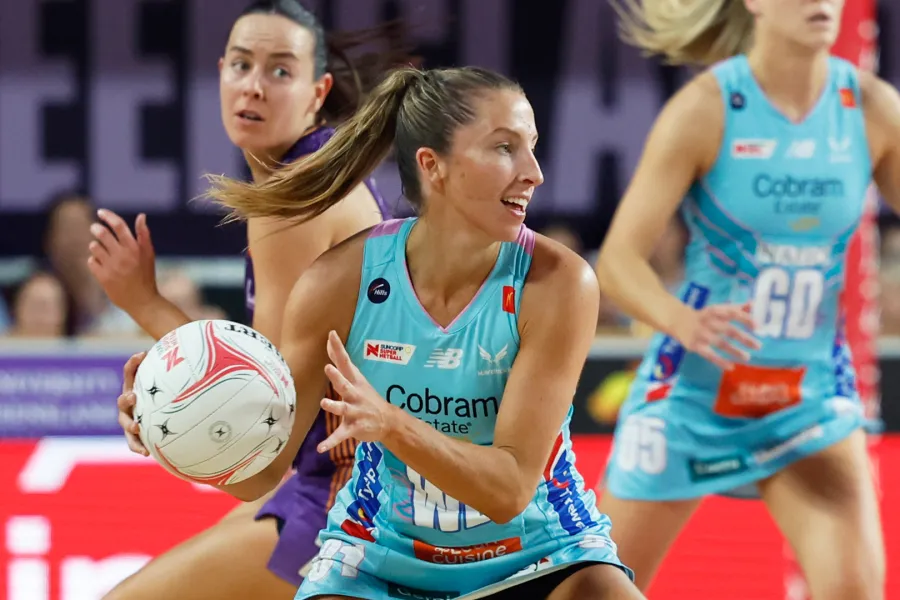
A major talking point this week was the Mavericks’ penalty count on Sunday afternoon.
They registered 30 more penalties than the Firebirds (75-35) but still came away with a crucial third win of the season 58-57.
Five players had a penalty count in double figures, with captain Amy Parmenter also given an official warning for a late contact.
With only six gains for the match, the two stats combined could have caused problems for the Mavs.
However, the ratio played in their favour instead as they gradually worked the Firebirds out of the contest.
The Mavs’ physicality wasn’t unwarranted, though. Majority of their contact penalties were genuine contests with only a couple late challenges – which were suitably managed by the umpires.
While the Firebirds were comparatively clean, they weren’t without faults.
Kelly Jackson had 17 penalties to her name – one more than Parmenter, the Mavs’ top-penalised – and Mary Cholhok also received a verbal warning and penalty for retaliation.
While the penalty count in this match makes it look dire for the Mavericks, other matches proved a good comparison.
Take the battle between the Vixens and Fever, for example.
The two sides had 67 and 65 penalties apiece in another reasonably close battle.
Kadie-Ann Dehaney had 19 to her name (13 contacts, equal to Parmenter) while the Vixens circle defenders combined for 41 penalties.
Erin O’Brien (13 contacts), Sharni Lambden and Courtney Bruce (both 11) were also heavily penalised in the circle.
So where do we draw the line?
Is it penalties outside the circle that cause questions to be asked?
Is it the timing during the match that questions the “fairness”?
Or is it how teams capitalise off penalties despite losing possession?
One thing is for sure: The Mavs aren’t the only team causing contacts.
NSW DERBY ASKS MORE QUESTIONS THAN IT ANSWERS
The Swifts got an important second win on the board on Saturday evening, defeating the GIANTS thanks to a first half blitz.
Realistically, it was all over for the GIANTS at quarter time, with just 14 goals on the board, including two Suncorp Super Shots, to the Swifts’ 21.
The Swifts’ rock-solid midcourt defence was the difference, paving the way to victory with 18 gains to the GIANTS’ six.
Sharni Lambden led the way with five alone (three intercepts), sharing both the wing and goal defence roles with captain Maddy Turner (three gains, two intercepts).
Unfortunately, the GIANTS injury woes continue with Lucy Austin ruled out for the remainder of the season and currently joined by key defender Jane Watson on the bench.
Jodi-Ann Ward and Erin O’Brien continue to pile on the pressure but were hampered by the height and strength of Grace Nweke on the weekend, while Amy Sligar was heavily covered by Tayla Fraser (24 assists) and Maddy Proud (four gains).
But for everything the Swifts threw at the GIANTS, Australian Diamond Sophie Dwyer stood tall.
The goaler can hold her head high after another high-impact performance, piling on 32 points (22 goals at 100 per cent and 10 Suncorp Super Shots) across both goal attack and goal shooter.
The Suncorp Super Shots tally from Dwyer is where the question needs to be asked about the Swifts.
While the defensive pressure through the midcourt was elite, Dwyer had far too much ease finding the two-point zone.
And while the Swifts could afford some long-range shots to fall thanks to the margin, in any other clash that would have been a massive danger sign.
The GIANTS came out on top in the second half, winning 33-32 including a huge 20-14 final term, and proving a crucial confidence-booster in a match to forget.
The Swifts’ defence was exposed in that final term, making their next few weeks critical.
CLINICAL VIXENS
Another week, another clinical Vixens victory.
It was not the smooth finish they would have liked but there’s plenty of positives to take out of their trip to Perth.
Once again, a return to basics enabled them to seal a win against a heaving Fever in front of a tough RAC Arena crowd.
The Vixens’ smooth ball movement and patience kept the Fever to their lowest half-time score in nine seasons (20 goals).
Efficient, smart play was the main takeaway from this clash, with the likes of Kate Eddy coming up with crucial turnovers in the first half.
Kate Moloney was her typical workhorse self while Sophie Garbin starred in the goal circle with 38 goals.
While Kiera Austin lacked her usual accuracy the goal attack still played a critical role at the centre pass and feeding the ball to Garbin.
Most importantly, the Vixens defensive effort forced heavy changes from Fever coach Dan Ryan, including sending Romelda Aiken-George to the bench for large stints.
The Vixens not only forced those changes but also capitalised further despite everything thrown at them.
It wasn’t a bad effort from the Fever, but the late injury call on Alice Teague-Neeld played a role with the side lacking a viable second option to Jordan Cransberg.
A better final quarter meant it wasn’t all doom and gloom, while another positive was the return of Ruth Aryang for the first time since Round 2, 2025.
ON THE STATS SHEET
Grace Nweke’s 61-goal haul puts her atop the scoring table this week (343 in seven matches), marginally ahead of Elmeré van der Berg (339) and Donnell Wallam (330).
Georgie Horjus leads goal assists with 147 ahead of Swifts’ Grace Whyte (142), while Mavs wing attack Maddy Hay (150 centre pass receives) still holds the lead for that stat ahead of Dwyer (149) and Horjus (139).
Courtney Bruce remains on top of the deflections tally again this week with 42 ahead of Shamera Sterling-Humphrey’s 41, while Latanya Wilson leads the league for intercepts with 21 followed by Jessie Grenvold (18) and Sterling Humphrey (17).