By Josie Huxtable
For Tusi Faasootau-Ale, sport has always been part of who she is, but her story begins far from the netball courts of Apia. One of eight children, Faasootau-Ale grew up in New Zealand, where she first fell in love with netball during primary school.
“My mum used to play netball when she was younger, so she wanted me to give it a try as she thought it was a good sport for girls – it kept you active, taught you teamwork and discipline. That’s how it all started for me,” she said.
As she got older, Faasootau-Ale explored other sports like volleyball and rugby, but netball always pulled her back.
When she returned home to Samoa, she found herself reconnecting and falling back in love with the game that had shaped her confidence as a young girl.
“When I came back to Samoa, it felt like everything came full circle,” she shared.
“Netball gave me so many opportunities when I was younger, now I was back where it all began – giving that same opportunity to other girls.”
Tusi Faasootau-Ale fell back in love with netball when she returned to Samoa.
Now, as Netball Samoa’s Country Program Manager, Faasootau-Ale leads programs that reach hundreds of women and girls each year.
Her role is supported through a partnership between Netball Australia and the Australian Government through Netball’s Ocean of Power – a program which invests in women sport leaders, officials, and administrators across the Pacific.
The program is increasing participation in netball for women and girls, creating more opportunities for women in leadership, and improving access to safe and inclusive competitions.
Through this opportunity, Faasootau-Ale has turned a lifelong passion into a platform for empowerment on and off the court.
Faasootau-Ale’s journey with Netball Samoa began close to a decade ago, when she joined as a development officer supporting community and school programs.
Faasootau-Ale currently serves as Netball Samoa's Country Program Manager.
Over the years, she’s worked her way up through multiple roles – learning every part of how the sport operates, from operations such as logistics and event management through to program management, participation, high-performance, governance and administration.
“Each role taught me something different,” she reflected.
“When I was a grassroots development officer, I was out in the villages coaching young girls and women how to play and seeing their confidence grow. Later, as high-performance coordinator, I learned how to support elite athletes through building training plans and performance targets.
“I’ve evolved and matured in each role and stepping into the Country Program Manager role has been a real highlight for me.
“The fact I’ve been in the shoes of many of my team members means I really understand what they’re facing on the ground. It’s helped shape the kind of leader I am today.”
Through the program, Faasootau-Ale has been able to access professional development and mentoring opportunities, connecting her with other women leaders across the Pacific.
Tusi Faasootau-Ale with Netball Samoa's Sport Development Coordinator Rosabel Tuatagaloa and CEO Justine Samu.
“Being part of the program has given me so much confidence,” she says.
“It’s not just about the funding it’s about learning, networking and seeing what’s possible. I’ve met so many amazing women who inspire me to keep growing.”
Faasootau-Ale emphasised the Netball’s Ocean of Power Strategic Leadership Workshops have been some of the most powerful learning experiences of her career, not only because of the expert facilitators, but because of the chance to share experiences with other women leaders from across the Pacific.
“We all learn from each other,” she explained.
“In one of the sessions, we heard from Netball PNG about how they structure their board and use those relationships to leverage sponsorship. It really opened my eyes to what’s possible and how we can use our own networks more strategically here in Samoa.”
The workshops, she says, have helped her recognise her own leadership style.
“One of the biggest lessons has been learning to step back and guide rather than jump in and do,” she said.
“Sometimes I still want to be out on the courts coaching, but I’ve learned to trust my team to take ownership and shine in their roles. As a manager of a small team, you wear many hats, but the key is knowing when to switch between them and when to stand back and support.”
Faasootau-Ale has taken part in multiple workshops as part of Netball’s Ocean of Power.
She also discovered a new passion through one of the sessions delivered by ABC International Development’s Sally Eeles, which introduced participants to the world of sports commentary and media.
“That was such a fun experience,” Faasootau-Ale said.
“I never thought I’d enjoy commentary, but once I tried it, I loved it! We as Pacific Islanders bring a different island flavour compared to Australian and New Zealand commentators and it’s so important to see our faces and voices represented in those spaces.
“I’ve recently been commentating for local competitions here in Samoa and received positive feedback online which has given me a lot of confidence.”
As Faasootau-Ale has stepped into leadership, she’s found that managing others is as much about guidance and trust as it is about planning and delivery. She sees mentoring as one of the most rewarding parts of her role.
“What I love about my job is being able to support my team to find their own way,” she said.
“Sometimes that means talking through challenges in their programs or helping them approach a community differently – but mostly it’s about giving them confidence to make decisions and back themselves.”
Having worked across almost every area of the organisation, Faasootau-Ale knows what it’s like to be in their shoes.
“I’ve been where they are, so I understand the pressures,” she explains. “It’s so rewarding to see them grow in confidence, come up with new ideas and lead projects. That’s when I know I’m doing my job well.”
Faasootau-Ale credits the women leaders of Netball Samoa for creating a culture that that recognises and values every part of a woman’s identity – mothers, professionals and leaders.
“There have been times I’ve had to travel overseas for workshops and I needed to make childcare arrangements for my daughter,” she recalls.
“The organisation was so flexible – they supported me to bring her with me and my parents cared for her in Sydney whilst I attended the workshops.
“That understanding meant my daughter has grown alongside me from in her pram to walking because the organisation embraces motherhood and doesn’t see it as a barrier to leadership.”
She says that kind of understanding and leadership is what makes netball special.
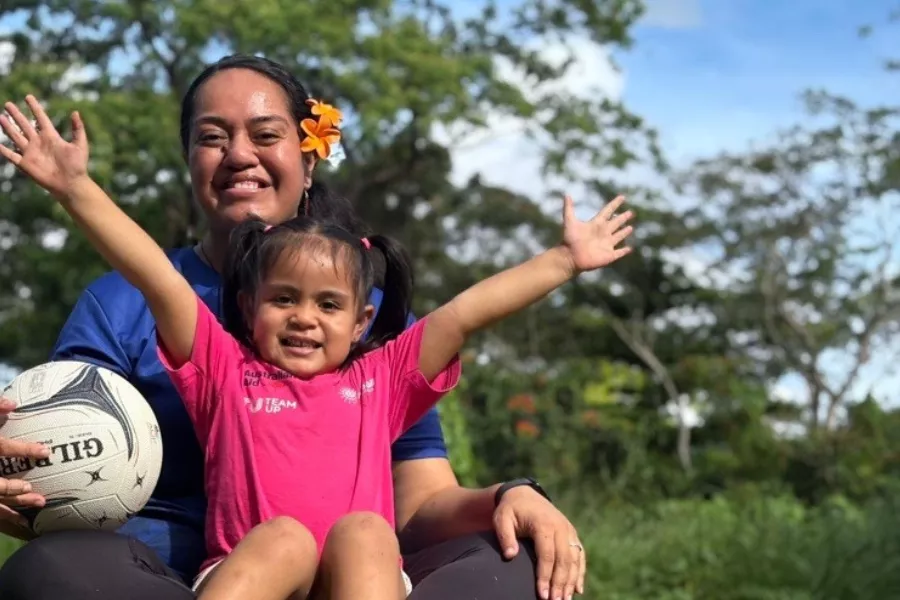
Faasootau-Ale with her daughter, who is her main source of motivation.
“We have mothers at every level, from our CEO to our development officers, and everyone supports one another,” she says.
“If someone’s struggling, we step in and help. It’s a space where women don’t have to hide any part of who they are. You can be a mum, a leader, and a professional — all at once.”
That culture of support has given Faasootau-Ale the confidence to take risks and grow into leadership roles. After several years with the organisation, she took a short break to focus on family – a decision she says ultimately made her stronger.
“Stepping away for a while helped me see how much netball meant to me,” she says. “When I came back, I was more focused and ready to take on bigger responsibilities.”
Since returning to Netball Samoa, Faasootau-Ale is focused on expanding opportunities for on-island Pacific players to compete at the highest levels including, future World Cups.
She notes that many of Samoa’s elite women’s netball teams are currently made up of diaspora players based in Australia and New Zealand.
“Some of our young athletes are having that mindset change where yes, they can see a career in it,” she says. “But because predominantly our elite athletes are made up of our diaspora, our local players need to see that there is actually a pathway and opportunity for them to represent the country.”
She points out the systemic challenges: limited access to high-performance facilities, regional competitions and funding.
“In the last Netball World Youth Cup, we only had one local player from Samoa and she was a travelling reserve,” she explained.
“It’s a challenge for us, but we’re building toward change – next year we have the PacificAus Sports Netball Challenge tournament where our local players will compete alongside Tonga, PNG, Fiji, and Cook Islands. That kind of exposure is so valuable in building skills, not just tactical, but mental and cultural too.”
Faasootau-Ale hopes this new wave of opportunities will inspire more girls in Samoa to see that elite sport is within reach.
Netball Samoa’s research shows that while many programs focus on participation, the next frontier is talent development and local representation at elite level.
Faasootau-Ale's message to the next generation is grounded in her own journey - and in the supportive network that helped her rise.
“My advice to other women is simple – just go for it,” she explained.
“There’s no perfect formula to life. We all go through different seasons, and each one teaches us something. Surround yourself with people who believe in you and will remind you of your potential, even when you can’t see it yourself. That support makes all the difference.”
Netball Australia is proud to support women such as Tusi through the Netball’s Ocean of Power Program that empowers women and girls to step into leadership roles and become champions within their community.
The program is an Australian Government initiative – reaffirming a shared commitment to supporting gender equality and positive social change through the power of netball.