By Linda Pearce
When World Netball introduced a dedicated Africa-focused role back in 2008, the continent had just three nations registered internationally.
South Africa, Malawi and Botswana remained active, but became just three of 21, including 13 full and three associate World Netball members.
“When they created the position it was because World Netball realised the huge potential of the African continent and what was in it for netball,” Namibia-based Joan Smit, WN’s Africa Regional Development Manager for 17 years, said.
What was in it? Plenty.
From 2018 onwards, there was a surge in participation numbers across the region, spurred in part by Cape Town’s 2023 hosting of the first Netball World Cup in Africa.
Uganda, Malawi, Zambia and Zimbabwe all experienced rises of more than 400 percent.
That historic event drew 3.2 billion social media impressions and reached a live linear TV audience of 14.9 million — more than double that of Liverpool 2019 — with South Africa and Pan Africa accounting for 78 percent of the overall viewership.
And when Namibia became just the fifth African nation to unveil a wooden sprung floor — one funded by an increasingly supportive government — and was thus able to host elite competition, it counted as another special day.
Not just locally but symbolically for the global netball movement as it pushed for inclusion in the 2032 Brisbane Olympic Games.
For this was a sport with a unique female reach into Africa — home to three of the top eight in the WN world rankings and eight of the top 20.
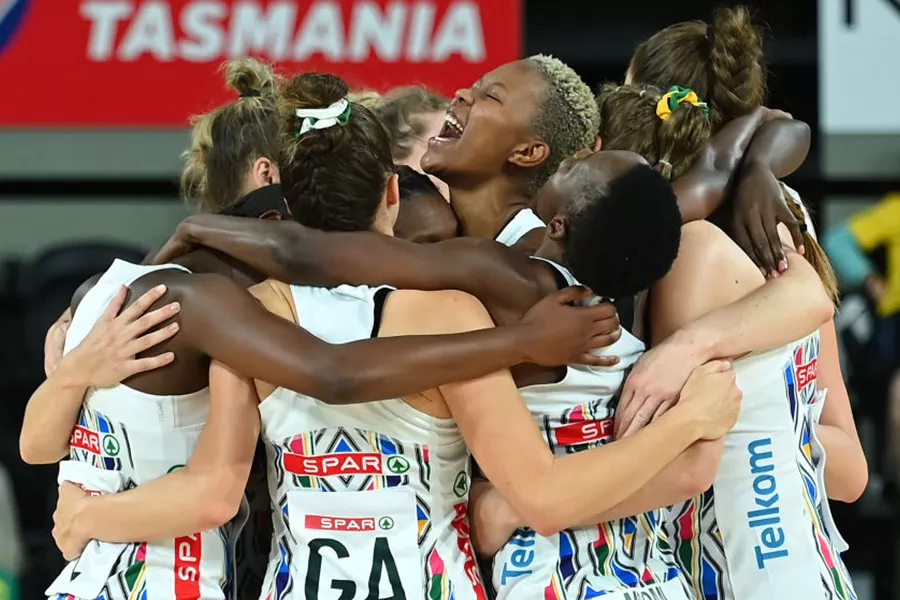
The Netball World Cup in South Africa created a surge in netball participation in the region.
All while the region’s potential and vast talent base — which YouGov research said included 6.6 million participants, half of all players globally, with Uganda and Kenya among the growth nations — remained a key opportunity.
“Netball was the biggest female sport in Africa. It was affordable, it was easily accessible, and it was extremely strong in schools,” Smit told netball.com.au.
“In Africa, every open space there could be utilised for netball. You only needed one ball to play, and you could make a netball post from anything available.
“The children in Africa didn’t mind playing on gravel if they needed to. Everybody wanted to play netball. Everybody played netball.”
Just as virtually everyone in the broader netball family could see the benefits that would have come with involvement in the Brisbane Olympics, with the number of signatories to the pledge for inclusion having topped 80,000.
It had been a now-or-probably-never moment to leverage the strength and influence of the sport in Australia to aid expansion and development for the benefit of so many more.
“We needed every team because people kept saying: ‘It’s only Australia-New Zealand, it’s only Australia-New Zealand’,” coaching legend Norma Plummer, who led the Origin Australian Diamonds to two world titles after playing in one herself, and later coached South Africa in two stints from 2014, said.
“I heard that so often in my time and I got bloody sick of it, so if we could get them all (including the Caribbean nations) up, I thought that was the secret.
“It was all there for the asking. You could see what happened if some of those countries got some decent support and coaching, the finance to back them, to get the coaching they needed. It was just such an eye-opener.”
As much as the athletic talent was unquestioned, so too were the challenges and barriers that remained on that diverse and volatile 54-nation continent.
Plummer took her coaching over to South Africa to help improve their national team.
Funding, for example. Resources, generally. Infrastructure. Governance, given that all local governing bodies other than South Africa were run by volunteers with full-time day jobs.
Access not only to quality coaching but also to umpiring and competition.
Despite a continuing strong presence in the UK Netball Super League, and a newer one in Singapore, a decline in African representation in world-leading Suncorp Super Netball left just Queensland Firebird Mary Cholhok of Uganda and Adelaide Thunderbirds’ South African recruit Elmere van der Berg among the 80 fully contracted players for 2026.
That was down substantially from the days when the Sunshine Coast Lightning’s dual premiership defender Karla Pretorius, star Vixen Mwai Kumwenda, Phumza Maweni and Peace Proscovia headlined a larger cohort able to share their knowledge and professionalism when returning to their respective African homes.
“We needed to know exactly what the franchises in Australia were looking for so that we knew what we needed to do to bring more African players back to Australia,” Smit said.
“Australia had been good to us,” she continued.
“Australian netball was so extremely strong and that’s why Australia kept on being the No.1 country in the world, and there was so much that we could bring through — the Mwai, the Peace Proscovia, the Mary — with the Australian experience that we could take back to our national teams.”
Plummer recalled being flooded by recruiting messages during her first tenure as South African coach, and laughed: “I was farming ‘em out. I couldn’t get ‘em out quick enough.”
“Stronger competition was, and remained, a key to improvement.”
With the 201cm Cholhok in the last year of her first contract, Plummer expected van der Berg to thrive on debut, describing the 24-year-old as, “a talent-plus, and an athlete”, one who was happy to turn and shoot and could prove to be another Gretel Bueta.
Plummer believes van der Berg will thrive in SSN.
“The kid’s got the natural ability to play it, go for it. Give her the top coaching for the next 12 months and look out after that. She’s just going to boom,” she said.
Indeed, Plummer insisted elite coaching was most essential to developing African netball.
“That’s the answer,” she said, noting the potential in Uganda, for example, which had finished a best-ever fifth at NWC2023.
The high watermark remained South Africa's surprise second place behind Australia in Birmingham, marking its return from apartheid exile back in 1995; a more recent success was a gallant fourth in Liverpool in 2019.
Malawi, a fixture in the top eight for two decades, and where superstar Kumwenda had grown up playing barefoot on dirt with a tree trunk for a goal post, an old tyre rim for a ring and a ball made from melted plastic in her remote village, now had the funds to hire a high performance guru from a field of applicants that included several from Australasia.
Discussing the seven African nations in the top 20, Cholhok said: “That’s amazing. Uganda was 7th and I felt like we had grown as a country; we had a lot of talent, we just needed a bit of funding, which would give us the equipment to perform better.
“With the She-Cranes I felt like netball was embracing and connecting different countries at international level — I felt like that was where netball was heading for the future.”
In late October, Smit presented at a sports conference in Namibia, detailing the quest for Olympic entry as well as the issue of government investment in a nation that had elevated sport and education to No.2 on a financial priority list headed by agriculture.
“Government finally realised what sport could bring to education, to the growth, to the development of a country and its citizens,” she said.
And to the empowerment, inclusion and advancement of women and girls in particular.
Uganda finished fifth at the last Netball World Cup.
“It brought them out of extreme poverty and put them in a world where everything opened up for them — not only sport, but education — and they became career women,” Smit continued.
“We had extremely strong leaders in women and if we could bring them into full leadership positions, not only in netball but also on national Olympic committee boards, in government and in the sports ministry, that was really where we made an impact.”
More widely, a boardroom mindset change was still needed, Smit stressed, noting that the willingness and excitement to play had remained constant, just not the appropriate facilities.
Still, see sprung floor (above), as Namibia joined Kenya, Malawi and Botswana as beneficiaries of the legacy program from NWC2023 in Cape Town.
There was also an expanding product born from 2019 in Liverpool, via the Community Sport Hub Site model, with five sites in Zambia having grown to 49 across Africa that created inclusive pathways while promoting education, leadership and social enterprise.
Meanwhile, the continent’s first strategic plan, designed to take netball through to 2032, was to be unveiled at the hotly contested Africa Cup in Lilongwe, Malawi, in December — notably, the second with a men’s division.
“The absolute focus areas were, of course, athletes — in development and high performance — coaches, umpires, and governance structures within countries. One of the key priorities was the establishment of proper and professional leagues in countries,” she said.
There were many others in this African story of challenge, potential and possibility, as it pushed for transparency, accountability and visibility.
“Netball was and for us would remain the biggest sport, and it was exciting to know that whatever was against us to promote it further in Africa, we still did it,” Smit said.
“World Netball didn’t have the funding to do all the development we wanted and needed on our continent of Africa, but we were fortunate that even in schools it was the preferred sport for women and girls, and everybody still wanted to play.
“For me it was important for the next 10 years to keep netball in that number one place in Africa, and then to keep bringing in more countries — to see if we could get a country that might eventually infiltrate amongst the first four in the world, and not remain where we were.
“But also to get more countries, new countries, to play netball.”
As, in the meantime, some of the older ones joined the international netball sisterhood — not just daring to dream but pushing to make a reality of Brisbane 2032.