By Linda Pearce
The day after the Diamonds’ shock loss to New Zealand in the group stage of the 2015 Netball World Cup, team HQ on the second floor of Parramatta’s Quest apartments hosted both a collective honesty session and a critical detente involving two senior players.
With the event format having been tweaked to draw some early interest and eyeballs through a trans-Tasman clash on the opening weekend, the hosts’ 21-test winning streak was snapped 52-47 in what coach Lisa Alexander now describes as “a kick up the arse, well and truly’’.
The upside was that it led to a palpable shift in attitude after some forthright team discussions, while vice-captain Kim Green and champion goal attack Nat Medhurst worked through cohesion issues of their own.
“We had really cross athletes, that’s the nicest way to say it, and we needed some honest conversations, and the one that had to happen was between Nat Medhurst and Kim Green on the transverse line,’’ Alexander recalled, a decade later.
“Seriously, those two, I could have hit their heads together sometimes, because they were brilliant when they were on, but they were just terrible when they weren’t on.
“And they were annoying because they’d thought of themselves individually and selfishly - and they know this, I've told them this - because they both wanted to handle the ball all the time.
“So we put the two of them together on purpose in our performance analysis session the next day, and they sorted their things out between them, and after that I saw absolute brilliance between the two of them.
“Kim Green did the really good unselfish thing. She allowed Nat to play the ball and then Kim fitted into the space and she did it so well. They were both amazing in that tournament. I was gob-smacked by how well Kim played in that grand final and she hadn't told anyone but she knew it was going to be her final international game.’’
Alexander recalled a disconnect between Green and Medhurst.
Alexander admitted she had also been “furious" with World Cup organisers for the ratings-driven fixturing of such an early clash between the two top dogs; a game in which defensive warrior Julie Prendergast (then Corletto) played just two quarters as part of an injury management strategy.
Yet it was a result that proved to be the turning point in Australia's quest for an 11th title, according to both their coach and captain.
“We just really locked in together. We weren't going to get beaten again after that," Alexander said.
“In hindsight, that early round loss was the best thing that could have happened," said former Origin Diamonds captain Laura Geitz.
With gun midcourter Madi Browne unavailable due to an ACL rupture and replaced by local bolter Paige Hadley, the 14th World Cup started just 47 days after the epic ANZ Championship final between the Queensland Firebirds and NSW Swifts that Alexander called, “the roughest game I’ve ever seen’’.
Five Swifts and three Firebirds contested that 57-56 bruiser, including Prendergast (who finished with a broken nose and the stirrings of a stress fracture in her foot) and an emotionally exhausted winning captain Laura Geitz.
“There was real animosity and venom out there,'' Alexander said.
"It was nasty, and we then had to turn that around in a few days when we went into camp and that meant people leaving their egos and baggage at the door.''
“We went from hating each other - and Kim Green and I had a bit of a biff out on court - and then all of a sudden we were captain and vice-captain leading the team a couple of weeks later," Geitz said.
“And that still happened, but you’ve got to put those emotions and feelings to bed and move on with a next-campaign kind of mentality.’’
Alexander recalled how the team had to leave their ANZ Championship rivalries at the door.
Prendergast, meanwhile, who had long battled through chronic knee issues that required almost full-time management, had the added complications of a “shattering” grand final loss, painful facial injury and cruel foot troubles that left her in a moon boot right up until the first training session in Sydney.
“No-one knew about it. We tried to keep it as secret as possible,’’ Alexander said of what she concedes was a “huge” selection risk, given that reserve Clare McMeniman was a healthy alternative but - unlike now - could not be called up should Prendergast break down.
Already a dual world champion and Commonwealth Games gold medallist, Prendergast had announced pre-tournament what she has since described as an enforced “body retirement”, while unaware just how serious her new injury would prove to be.
In the event, it was in the first half of the World Cup final that the 28-year-old’s stress fracture gave way, and she would play out her 52nd and farewell test with what, mercifully, she says she did not discover until later was a broken foot.
“Sounds a bit silly now, but I guess at the time my adrenalin was so high and I’d announced my retirement, so nothing was going to stop me unless Lisa took me off,’’ Prendergast said.
“And it wasn’t until the next day when I got it scanned that it confirmed that it was broken. Obviously it just hurt a lot at the time.’’
Four years later, Prendergast was conducting a clinic in Bendigo when one youngster complained about a sore finger. Which prompted another coach on site that day to point out that, just over there, was someone who had played in a World Cup final with a broken foot.
Geitz believes the selfless Prendergast - who was always a regular on the physios' table but shared nothing of her latest physical struggle - deserves the same admiration as footballers who are so often loudly lauded as heroes.
“Jules managed that the whole way through in significant amounts of pain. She had problems with her knees. She was on so many painkillers, poor thing… just an incredible athlete with obviously a ridiculously high pain thresh-hold," she said.
That loss to the Ferns had piled the pressure on the host nation, and Alexander admits she was feeling it leading into the blue-ribbon final before a world record netball crowd of 16,752 that included every Australian World Cup captain since competition began in 1963.
Alexander took a risk with the injured Prendergast.
In the interim, the Diamonds had regrouped, sought umpiring input on interpretations (particularly contact) and introduced some levity into the warm-ups to lift the mood, while bunkering down with in-house meals planned and prepared by dietician Kerry Leech.
Internal competition for game time was, Geitz recalls, particularly high, with the skipper admitting it could have been argued - and, in fact, was - that Sharni Norder (nee Layton) was the in-form keeper coming in.
Yet Alexander stuck with a not-at-her-very-best Geitz to start in The Big One despite an internal push for Norder.
“Laura gritted her teeth. As soon as I saw her go out on the court for the final I knew we were going to get a special performance and we got it,’’ Alexander recalled of a stunning 16-7 first term that had shrunk to three by the final whistle but was never seriously threatened.
“It was won in the first quarter. We were far enough ahead, and we knew all we needed to do was to just keep scoring off our centre passes and play good basic netball. We didn't have to do anything fancy and we were just hoping that Julie would get through.’’
Geitz recalls a 15-minute blitz in which everything came together.
“We were like, ’oh, we’ve probably got this here’,’’ she said of Q1.
“Then I remember also having a feeling in that fourth quarter of like, ‘oh, we could actually blow this'.’’
Geitz remembered thinking they might lose the final.
In the end, one quarter was just enough.
Shooting colossus and soon-to-be Liz Ellis Diamond winner Caitlin Bassett (48/51) was the Diamonds’ anchor throughout the tournament, Medhurst and Green also outstanding on the day, and centre Kim Ravaillion and wing defence Renae Ingles excelled in a line-up unchanged for the 60 minutes.
On the bench: Norder, Hadley, Erin Bell, Bec Bulley and Caity Thwaites.
Super-sweet, too, for Ingles (nee Hallinan) who had missed selection for the 2011 Singapore World Championships under Norma Plummer despite winning silver at the 2010 Commonwealth Games.
“I told her why and she worked so hard to address those weaknesses,'' Alexander said.
“It was just some little things in her one-on-one defence, just real subtle things, and also a bit of psychology in her approach.
"I just said to her ‘you’re a bit too full of it, Renae, you’ve still got to do the work’, and then she just put her mind to it and did it and I was so pleased she got her opportunity and didn’t let it slip.''
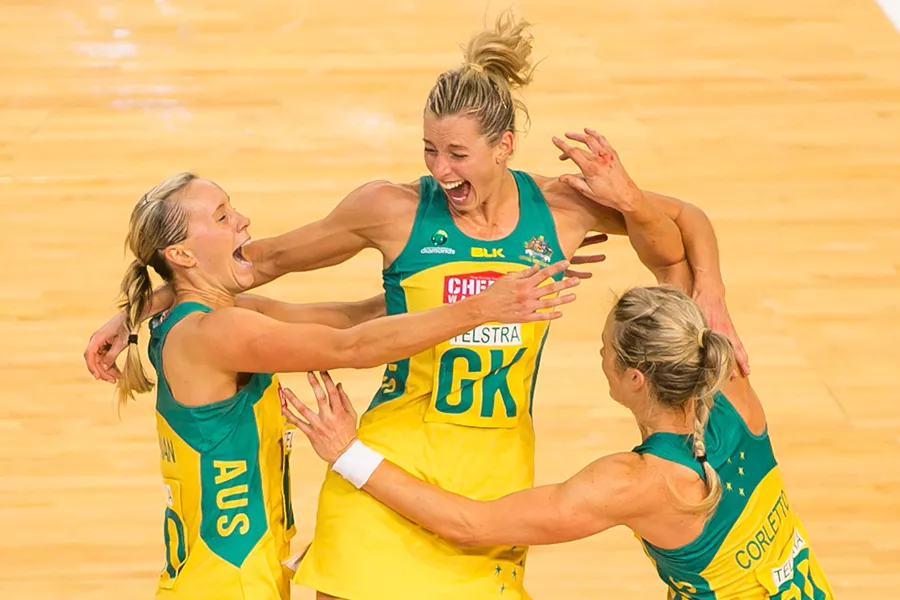
As the tears flowed, babies were kissed, opponents were hugged and former captain Liz Ellis in the commentary box admitted it was particularly emotional watching Prendergast’s brave swansong.
“She’s been such a fine player for Australia, a magnificent athlete, and she’s given up a lot to get here. What a moment." she said.
Indeed. Alexander, for her part, still cherishes the locker-room photos of a group she considers the standout of her 102-Test career.
Alexander believes the 2015 Netball World Cup team was the best she ever coached.
“Individually, they were outstanding athletes, the seven that took the court in the final, and together they were the most powerful team I've ever coached,’’ she said.
“It was a joy to coach them. I rate them with the best of the best.’’
As does Geitz, who recalls a feeling of “safety” playing with this super-competitive cohort, given that each end of the court trusted the other to either win ball or convert it.
And a connection shared will last a lifetime.
“We're all in different states of Australia,’’ said the celebrated leader and 71-game Diamond.
“But there's that common bond now, that thread that will link us forever. Which is such an awesome thing.’’