By Linda Pearce
A captain’s secret pregnancy. A superstar’s ruptured ACL. An untimely flat tyre on match day. A pricey and slightly panicked restaurant dinner after a monumental early round upset that changed the course of the tournament.
Uncomfortable questions, too, over the whereabouts of coloured athletes from the post-apartheid South Africa - a team which included a little-known Proteas shooting giant called Irene van Dyk, who would start a famous rivalry with young Diamond Liz Ellis in a grand final no-one had predicted.
All were part of a plot that unfolded in the UK Midlands city of Birmingham, four years after netball’s breakthrough 1991 moment in Sydney, and in a far less-hospitable time zone for those in Australia watching the world No.1 win their seventh world title from the nine played.
Coach Jill McIntosh had to avert her eyes when her team, having been invited to lunch in the Cotswalds by popular Netball ACT official Pat Dart and her husband Doug, decided to test out the flying fox.
During a world championship.
Nope. Couldn’t look.
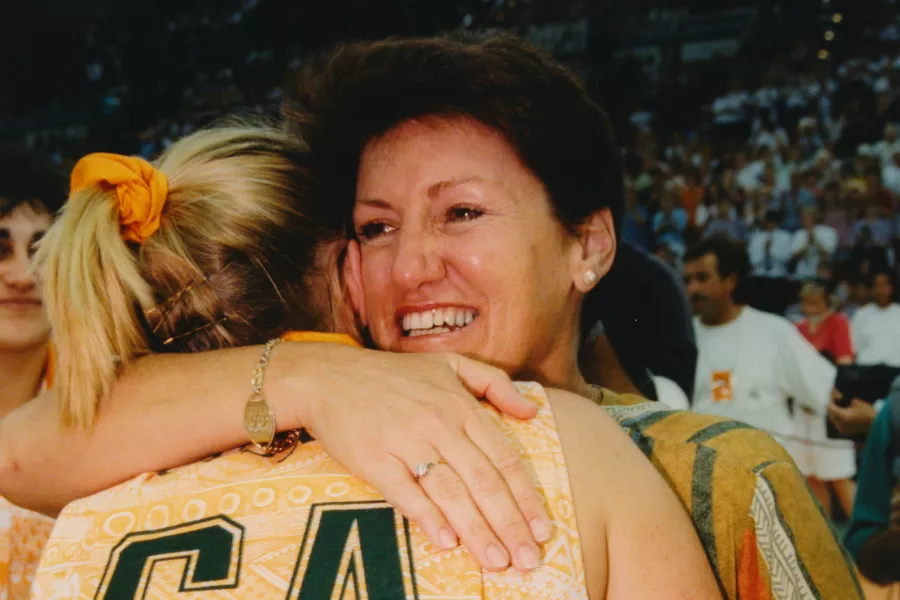
The 1995 final itself was far less stressful viewing, as the surprise Australia-South Africa decider that interrupted the trans-Tasman duopoly delivered an emphatic 68-48 scoreline and triggered a next-level celebration.
Then there was Australian captain Michelle den Dekker, who was 12 weeks pregnant, trying to hide why she was buying bigger bras while quietly enduring pre-and-post-match rectal swabs from the trusted team doctor at a time when far less was known about playing elite sport while expecting.
“Dr Grace Bryant and Vicki Wilson held my secret really really well,’’ den Dekker said. “For me, this one was really amazing, really special, because I knew it was going to be my last.’’
Early in the world championships, though, an enthusiastic welcome back for the South Africans quickly soured when there was no sign of the three athletes of colour required in the travelling squad required by the new Nelson Mandela-led government.
Australia claimed their seventh world title in 1995.
The official team contained 12 white athletes, while the trio of emergencies was accommodated at an unknown location elsewhere and neither seen nor heard. “We all knew, and we were aghast,’’ Wilson, the Diamonds’ vice-captain and senior shooter, recalled.
“There was a lot of turmoil, a lot of rumour and innuendo around the South African team and the welfare of the rest of the squad, and there was a lot of disharmony within the playing ranks of world netball. Unfortunately the South African players copped the brunt of that. It was a tumultuous time.’’
Headlines aplenty on the court, too. Having had just nine months to prepare after 25 years of apartheid isolation, the Proteas shocked New Zealand 59-57 (van Dyk scoring 56) on day four to leave Kiwi captain Sandra Edge in tears and upend the tournament, given that the top two would henceforth be housed in the same half of the draw.
“Not for one moment did we ever think that South Africa would beat New Zealand,’’ McIntosh said.
“But as the match wore on, we were feeling a bit sicker and sicker because we were due to play the loser of that match the next day and we had assumed it would be South Africa, so we had everything planned for that.
"We weren’t meant to meet New Zealand so early on. It was all so sudden. And the funniest thing was that straight away the players said ‘well, we have to go out and have pasta tonight because we can’t rely on the food from the university accommodation if we’re playing the Ferns’.
“The only pasta restaurant we could find was a TGI Fridays, which turned out to be a very expensive exercise.’’
Yet the avoidance of more awful recycled beef paid off on day five, in a clash that was effectively an early grand final and a typically tight affair that was not broadcast live in Oz. The casualty was spearhead Wilson who ruptured her ACL just before half-time - requiring reliable understudy Jenny Borlase to step in and up.
“I knew as soon as I did it because I heard the crack, and from then it was a roller-coaster of so many emotions for the team and for me personally,’’ Wilson said. “Of course you’re emotional, you’re upset, but I do remember sitting there and thinking it was terrific that we won, and were going through to the finals.’'
(Interestingly, Wilson’s misfortune had come on an non-cushioned vinyl surface rather than the usual sprung wooden floor, in some questionable conditions that included concrete blocks behind the goal posts and led to a pre-tournament ultimatum from Netball Australia that players sign forms absolving it of any legal responsibility for injuries suffered as a result.)
Everyone contacted for this piece is united in their retrospective praise for Borlase, who nailed her well-deserved opportunity and scored at almost 90 per cent accuracy for the tournament, including a star turn of 37/41 in the final.
The skipper, meanwhile, had plenty else going on. Den Dekker had only shared her pregnancy with Wilson - “I said ‘you’re what?’,’’ her mate recalled - and Dr Bryant, and the normally flat-chested defender raised eyebrows when it was discovered that she, of all people, had been bra shopping.
“They were like ‘what’s the matter with you? Why are you even wearing a bra?’,’’ den Dekker said with a laugh.
“And I was having difficulty running because my boobs were so sore that I had to wear two bras, so I was trying to hide those little things, those little body changes.
“And Grace Bryant took my rectal temperature in the toilet before and after every game to make sure that my core body temperature wasn’t elevating, because they didn’t have the data or the history to know how safe you were back then.’’
It was a huge occasion for the Aussie group.
Problem-solving arrived in a different form one match day upon the discovery of a flat tyre on the team mini-bus. How would they get to the National Indoor Arena? Would they be late?
Enter assistant coach Lisa Beehag.
“Ah, yes, the mechanic,’’ quipped Wilson.
“She was a machine. She was jacking it up, issuing instructions. Everyone else was going ‘holy shit, what do we do?’ Lisa was just boom boom boom, jacked it, getting those nuts off, and we’re all lifting the tyre and putting it on.’’
While New Zealand had to settle for the consolation prize of a bronze medal thrashing of England, Australia justified its top dog status with a 68-48 belting of South Africa to raise the first World Cup trophy ever presented, playing in a big-for-netball-at-the-time 12,000-seat venue.
Back from 1991 were den Dekker, Wilson (who needed a crutch to make it onto the dais) and star midcourters Shelley O’Donnell, Carissa Dalwood and Simone McKinnis, while debutante Ellis and Nicole Cusack were key inclusions at goal keeper and goal attack respectively. Such was the depth that a young Kathryn Harby was mostly stuck on the bench.
While rating the 1991 group slightly higher, given their performance under immense pressure in the gold medal game, Den Dekker described the 1995 cohort as part of “a really spectacular generation of athlete’’. McIntosh, for her part, regards the 1995 team as at least the equal of any she coached to 88 wins from her 94 Tests.
In fact, it still amuses the unflappable McIntosh that famed Trinidadian coach Jean Pierre was prompted to take her behind a curtain on finals eve to advise how to stop van Dyk.
“So I don’t know whether she didn’t think that I was capable of coming up with a strategy to beat Irene!’’ McIntosh recalled. “I very politely said ‘thank you, Jean. No problem. We’ll be able to do it’.’’
The savvy, springy Ellis was superb, and a storied personal rivalry was born; one that grew after van Dyk’s sensational defection to represent the Silver Ferns from 2000.
Den Dekker said the Diamonds had played their real grand final nine days earlier, and felt this one was something of an anti-climax, despite the unique situation of almost the entire crowd supporting the title favourites.
As Wilson explained: “Normally people would cheer the underdog, and for everyone, even New Zealand, to be cheering for us was really bizarre.’’
It was a similar feeling for McIntosh, in the most emphatic World Cup decider ever played, and one that allowed the retiring captain to soak up the relatively low-stress experience of what so few knew was her farewell game.
“You can simply enjoy the environment and you almost feel like you’ve got the ball on a string when you’re up by that much,’’ den Dekker recalled. “It’s lovely knowing that you’re going to have a gold medal and you can just simply take in the moment.’’
And the celebrations? McIntosh struggles to remember, while feeling “sure we would have found a pub somewhere’’, but at least that baby news could finally be revealed to the broader group as bubbly was chugged from plastic cups in the locker-room.
Some very spirited partying is still vivid for Wilson, however: “Let me just say that Carissa and Simone led the way in those celebrations, which were a bit wild, and went long into the night.’’
The Proteas could also toast a successful on-court return to a world stage in need of extra challengers for the good of the sport. Indeed, many years later, McIntosh went over to South Africa for a coaching exercise and attended a function recognising the 1995 silver medallists - whose best finish has been fifth in the 30 years since.
“The dinner was lovely,’’ McIntosh said. “But it was like they had won the World Cup, so I politely had to remind them that they didn’t.’’
That was Australia. Again. Title no.7 and, for many reasons, another to remember.
Next: Ten years since Sydney, 2015.