By Linda Pearce
When the Australian team and coach Joyce Brown checked into their university accommodation for the 1975 World Championships in Auckland, they discovered a filthy and decrepit contrast to what was provided for their host and great rival New Zealand.
“In your room - it was actually a cell, not a room - you got a bed, a few blankets, some fleas and some bed bugs,’’ ex-shooter Marg Molina (nee Gollan), said, 50 years on.
“Everything was dirty. It was just the pits.
“I still feel the grime of the whole place. New Zealand was in different accommodation which was much flasher than what we were in. It was psychological warfare.
“Joyce tried to complain but we were always told that, as Australians, we had to keep ourselves nice and avoid any 'international incidents’.
"It made us probably become more of a unit, though. Adversity sort of brings you together.’’
So, by necessity given the lack of a television or any other diversion, did the card games assist with team morale, from 500 and Euchre to poker and snap, often played on an ironing board or sitting on a hallway floor.
“We had to learn how to entertain ourselves,’’ captain Margie Caldow recalled.
“But it made us bond more together because of it.
"It was like, ‘we’ll show you. You put us in this’.’’
Breakfast at the one table provided for the five unfortunate teams at Rocklands Hall was apparently either Cornflakes or toast. And to call the very basic evening meal a buffet was to make it sound far grander than it was.
The Aussies bonded in Auckland.
Norma Plummer was reminded of the ramshackle house on the TV show The Munsters, and supplies netball.com.au photos of the building that housed the kitchen while in such a shabby state that the outside stairs were roped off for safety.
The short beds in the tiny hostel-style rooms meant that goal keeper Cheryl Sidebottom (nee Stevenson) had to sleep curled up, and the fumigators were called in after wing defence Pam Redmond awoke covered in flea bites.
There were no private shower cubicles, either, necessitating what could rightly be called, ahem, open lather.
“The place was disgusting,’’ Plummer says.
“Joyce has blown her stack, it was that bad, and I remember (senior official) Eunice Gill came around and said ‘Australia don't complain’. Well, we weren't happy, and we were actually struggling as a group on the court.
“We hadn't had a lot of time together beforehand, and in the games it really hadn't clicked. But in the third last game it all came together against Wales; I do remember that.’’
Outdoor conditions on unforgiving asphalt at the Windmill Road courts, often in the wind and rain, were the other challenge, but at least they were common to all 11 teams.
That included debutantes Fiji and Papua New Guinea, as well as a tall and talented England side that conjured the shock of the round-robin tournament by upsetting New Zealand 39-38.
The weather was a challenge for all the teams.
“It’s always nice to see the old enemy go down; takes the pressure off a little bit,’’ says Caldow, the champion goal attack who had returned to the team after five years and two children.
“But I just knew New Zealand would come back, they’d step up, and they were in front of their home crowd as well.
"It was good for England, and good for the game, possibly, but I knew the Kiwis would come back fighting.’’
Australia, meanwhile, returned from their bye to dominate Wales 67-14, then defeated England 41-36 to remain undefeated and set up a highly-anticipated final day clash between the two top seeds that would decide the crown.
A win or a draw would give the Aussies their third title from the four played.
A New Zealand win, after a conveniently timed rest day for the home team, would result in a three-way tie with England.
Even the selection system, based on performances at the national titles, was far different half-a-century ago.
Players had to pay a deposit to nominate for the national team to show that they could afford the financial contributions that would be necessary to help cover travel and other costs.
Dinner dances and lotto tickets were part of the fundraising efforts, according to Molina, while playing uniforms were handed back to be re-used by the next team.
The players had to fundraise and pay a deposit to prove they could afford to contribute to the team's financial cost.
“There were lots of weird things back then,’’ says Caldow with a laugh.
“There was no money there, and what you didn’t raise you had to put in yourself.’’
South Australian Julie Francou, a future captain, was dropped from the travelling squad after failing to pay the deposit, and replaced by midcourter Maryanne Kruyer.
Nor was there any interchange rule, even at the quarter and half-time breaks, except in case of injury.
“It was difficult because if you didn't get picked in that starting seven, you sort of thought, ‘oh, well, that's it. I'm done’,’’ says Molina, who spent the final on the bench as the reserve shooter and unofficial score-keeper for Brown.
“It wasn’t something you would dwell on, because it was just the way it was, but you knew that unless someone got a serious injury and came off the court you didn’t get an opportunity.’’
The final day, September 4, was damp and blustery, the partisan crowd of around 5000 in the temporary stands urging on a home side captained by Shirley Langrope and with Yvonne Willering a slightly menacing figure in defence.
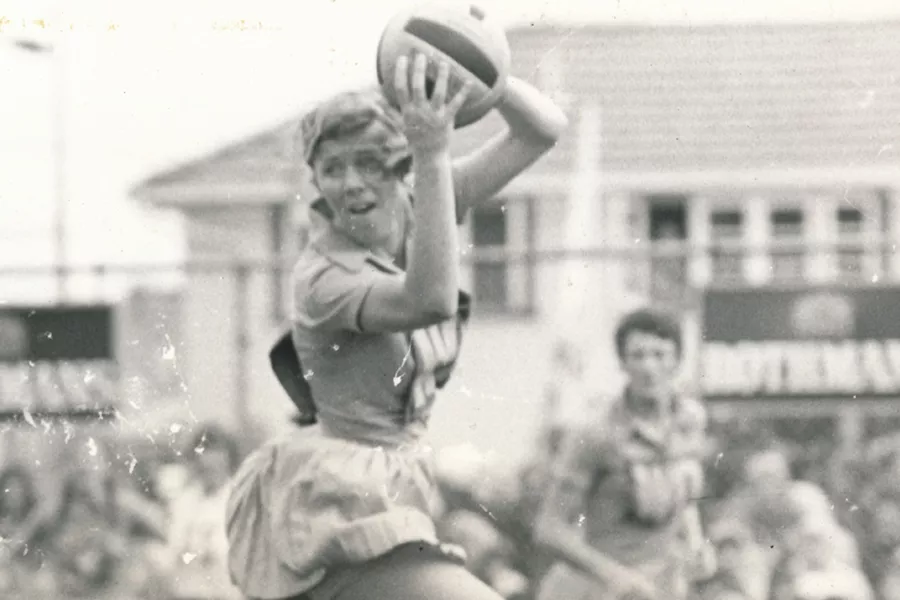
Booed in the warm-up, the Australians had prepared for heavy conditions by training with leather balls dunked in buckets of water, but were soon soaked through their yellow pleated skirts and too-small polo tops due to a mistake with the sizing.
“The day we played New Zealand there was rain and wind and the leather ball just felt like a medicine ball by the time you tried to shoot with it or pass with it - the conditions made it extremely difficult for everybody,’’ says Caldow.
“The shooting was just such a question mark, because you weren’t quite sure where it was going to go or if it was even going to hit the ring.’’
The Kiwis led 12-7 at quarter-time, as the local commentators emphasised the “rugged, robust style of the Australians”, while declaring: “It’s hard, tough and mean out there and the Australian girls have got a win-at-all-costs attitude.’’
The 1975 side faced tough conditions in New Zealand.
Molina counters that there was nothing overtly physical about the Australians, but simply that their one-on-one defence contrasted with the Kiwis’ traditional zone. Nor were there any apologies for desperately wanting to win.
“It was all on the line - completely and utterly on the line,’’ she says.
“It was up and down, up and down, up and down. It went right down to the wire and if we’d lost it was gonna be a three-way tie, but by drawing we won by a bee’s dick.’’
When Plummer took a tumble in the wet during the third quarter, Brown - who would go on to also coach the triumphant 1983 and 1991 teams - ran onto the court in her green beanie to provide such medical attention as there was without a doctor or physiotherapist on the support staff of just two.
There was no blood rule back then and nor was there time for Plummer to pick the gravel out of her knee or hands as the seesawing game continued. Yet she can laugh that the false eyelashes favoured by some of today's Diamonds would have been washed off by the rain.
On this afternoon, there were frosty blonde tips and mullets, low pigtails and high socks, with the England and Jamaican umpires - Miss Haynes and Miss Robinson - wearing hooded raincoats as a Caldow long bomb put the Aussies ahead 34-32 with just under three minutes to play.
After clawing back to level, the Ferns had the chance to win through a final attempt from Beth Carney before the final whistle left the teams locked at 34-34.
“They were livid they didn’t win, being at home and all of that,’’ says Plummer, who would go on to coach the Diamonds to the 2007 and 2011 titles in Auckland and then Singapore.
“Playing for Australia, there’s nothing better than that. It’s fantastic to be a player and win, and even now you always want your girls to get the feeling of what winning a major like that's about. It's just terrific.’’
The Aussies won their third title.
And if there were no medals, not even a team trophy, then nor was there an official post-match celebration, with Plummer recalling a sour and subdued gathering that was more like an Annual General Meeting.
“There was no congratulations. There was no acknowledging the winning team. There was nothing. We’re on long benches like church pews, and we’re sitting in the second back row even though we’ve just won.
“Then, as we finished, Fiji was sitting in front of us and they stood up, turned around and put a flowered lei around our neck, and that's the only thing I got out of a world cup. I thought New Zealand were terrible, really, as a host.’’
Caldow can not recall that last event, quipping that presumably the world champions returned to their “first-class accommodation. Might have had dinner in with everybody else and that would have been it. Played cards, perhaps, who knows?’’
Nor was there any recognition after the team’s flight back home across the Tasman, other than a few Netball Victoria officials apparently greeting their five state representatives at the airport.
“Nothing. There was nothing,’’ Caldow concurs.
“But, anyway, it was all good. We felt proud of ourselves, with what we’d achieved.’’