By Linda Pearce
A young Liz Ellis remembers the thrill of hearing about a potential crowd of just 800 people watching from temporary stands erected at the old Anne Clark Centre in Sydney during netball’s first national league iteration in the early 1990s.
The former Diamonds’ captain, now Chair of Netball Australia, also recalls the next stage of the sport’s development locally, which was shifting to the State Sports Centre which had a capacity of about 4000.
The stress around the decision to upsize in the modest but still historically monumental Esso/Mobil Superleague era, was enormous.
One game was scheduled at the bigger venue that first year. Then two. Until it was every game.
“I absolutely remember the struggles and how hard it was, and the size of the decisions, and the angst that went into going: ‘Oh, my God, will we hire the State Sports Centre? What if 4000 people don’t turn up?’,’’ Ellis recalled.
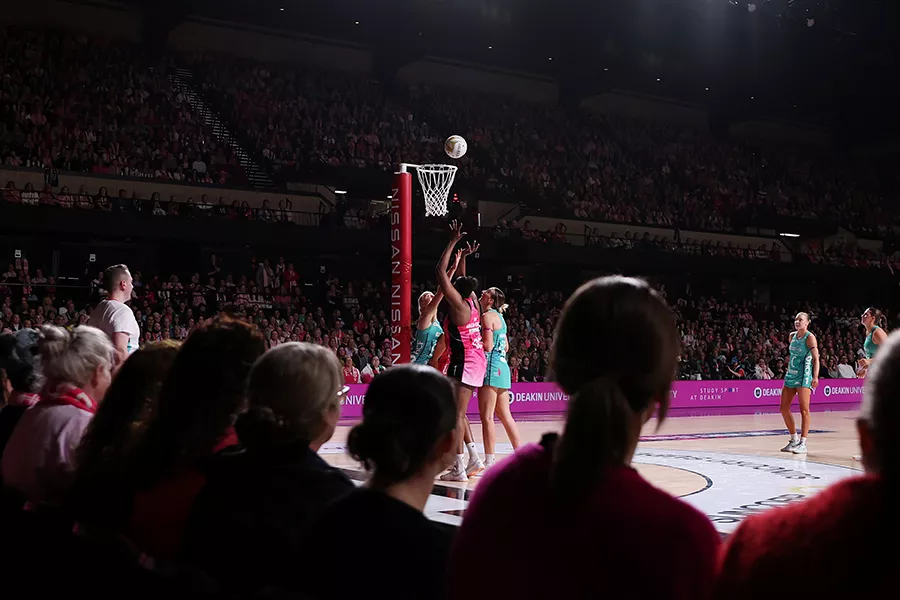
This Saturday more than 14,000 will flock to Rod Laver Arena in Australia’s sporting capital, for the Suncorp Super Netball Grand Final with a Mixed Social Club option among new and exclusive fan connection experiences before the main prime time event.
“It is light years away from when I was playing,’’ Ellis, the four-time Swifts premiership captain whose decorated on-court career finished in 2007 after a third world championship title to go with two Commonwealth Games gold medals, laughed.
“It’s like netball on another planet.’’
Ellis was a four-time premiership captain of the Swifts.
While, internationally, the first world tournament was back in 1963, it was in 1985 that the month-long Esso Superleague was launched as a pilot program with eight “A-grade premier clubs” and a slim budget-for-its-times as Australia’s inaugural nationwide sporting competition for women.
And the fact that the 2025 grand final will be played at the season climax’s largest venue yet is a significant signpost on the road to even bigger things.
Four decades ago, the nine-game Superleague was a joint venture between the All Australia Netball Association (now Netball Australia) and the Australian Institute of Sport as the latter sought strong local competition for its scholarship holders.
Contested across two zones by the state league champions from five states, two challenge competition winners and the powerful AIS side, there was TV coverage on the ABC, flights subsidised by TAA and footwear supplied by Dunlop while venues such as Royal Park initially played host.
Few could then have imagined that, after a name change to the Mobil Superleague and some format tweaks along the way, the humble forerunner to the Commonwealth Bank Trophy that ran from 1997-2007 and morphed into the trans-Tasman ANZ Championship from 2008-2016 would become the drawcard it is today.
While the peak attendance for any netball game remains the 16,752 present for the 2015 World Cup final between Australia and New Zealand at the Sydney SuperDome, the national league record of 13,908 was set at the 2022 decider between the West Coast Fever and Melbourne Vixens at Perth’s RAC Arena.
The past two grand finals were also sellouts, at the smaller-capacity John Cain Arena (9622) and Adelaide Entertainment Centre (9649), respectively.
Now for Rod Laver Arena, where netball’s only previous national league footprint remains the 2012 ANZ Champs Semi Final between the minor premier Vixens and New Zealand’s Northern Mystics. This was due to a scheduling decision necessitated by the unavailability of regular venue Hisense Arena (now JCA).
The only time netball has been played on Rod Laver Arena was in 2012.
“The day you can play on Rod Laver Arena is very special. It’s been a bit slow happening but I’m so pleased that it is,’’ the legendary Norma Plummer said.
A successful former Diamonds and South African national coach, Plummer led winning teams in the Esso/Mobil Superleagues and took the Melbourne Phoenix to the inaugural CBT premiership before heading the AIS/Canberra Darters program, returning in 2012 to coach the West Coast Fever in the trans-Tasman competition.
“I think it’s absolutely sensational. It’s a big step,’’ Plummer continued.
“To me, it’s expressing that the game’s that good and it’s worthy of it.
“With the support we have and all the supporters, I just love the thought that more people will get a ticket to see the grand final, because they sell out that quick.’’
Indeed, what was once strictly game-focused is now truly an event. Adding to the existing Grand Final Lunch and open training sessions, the 2025 version will feature fan experiences such as a Mixed Social Club on the RLA rooftop with a DJ and the chance to mingle with netball identities, and an exclusive Inner Sanctum option featuring premium hospitality.
“It’s not just the game itself, it’s all the things that are happening around it that’s really exciting,’’ Ellis said.
“Back in the day it used to be that everyone just turned up to the game and there might have been some face-painting out the front.
The SSN Grand Final has grown from a game to a whole weekend experience.
“Now there’s going to be this whole activation area and there’s any number of functions and things happening before, and you can choose your own adventure in terms of how you want your day or your weekend and your travel package to look.’’
Rising crowds across the competition continue to be a feature of Suncorp Super Netball, which in 2024 was the highest-attended Australian women’s sports league ever, with 366,222 across the 14 round season and finals.
All a far cry from 1985, when a meagre domestic calendar was completed by the annual national carnival and otherwise centred around state competitions, with the fledgling Esso Superleague a welcome addition.
“They’d have an outdoor grandstand and the games were telecast, but it was your netball nuts that were there,’’ ex-Diamonds defender Keeley Devery recalled.
Devery represented the triumphant AIS in that inaugural season before returning home to Sydney, where her club team Randwick typically formed the basis of one NSW entry.
She later became head of netball for Nine’s Wide World of Sports after spending 21 years as a sports producer for Foxtel. She is now on NA’s history and traditions committee, pleased yet not stunned at how big the sport has become, and set to be among the masses at RLA for the pre-match entertainment and first centre pass.
SSN crowds continue to break records.
“I think it’s just fantastic. I’m not 100 per cent surprised because you think ‘Well, that’s where it should have been’,’’ Devery, part of the world championship-winning team in 1991, and captain of the 1995 Mobil League champions Sydney Electricity, said.
“I’m probably more surprised it’s taken this long, to be honest, because it always had a good following, but people would never know it was on.
“It was more about getting the message out that it was such a great game and a great spectacle. The standard has always been great in Australia. It’s about time.’’