By Stephanie Smarrelli
Australian Diamonds head coach Stacey Marinkovich says balancing form, experience, versatility and future potential was central to selecting Australia’s Commonwealth Games team.
Australia will take five Commonwealth Games debutants to Glasgow as part of a squad designed to blend established international performers with emerging talent.
“You've got to get the balance right,” Marinkovich said.
“You've got current performance that's right in front of you and then there's also the understanding of what that performance can look like at its best collectively and what we've seen over a period.
“I've got all the data, all the stats, I've watched a lot of netball over the years to know where the players are at and whilst there might be an outside perspective that players aren't in form there's skillsets that are very strong and prevalent to what we need in the Diamonds environment.
“That ability to be able to bring them in, we pride ourselves on that growth mindset and that adaptability...making sure we get the best out of them when they're with us.”
That adaptability will be crucial as the Diamonds move from SSN into the international arena, with Australia set to face a Commonwealth Games pool featuring England, South Africa, Malawi, Tonga and Northern Ireland.
With many opposition players already familiar through the SSN competition, Marinkovich believes the ability to adjust quickly and perform in different situations will be key across the tournament schedule.
As will the individual strength of each player.
“You've got to have your physical capacities,” she said.
“It's a big load to manage on the body to be able to peak at the end of a tournament.
"With our draw, we've got England quite early and we've got South Africa, so it's not like you're building towards a couple of games at the end.
Five debutants have been named in the Commonwealth Games team.
“It's competitive right from the start.
“The versatility and adaptability of the playing group is important we want to be able to change up the way in which we use players’ strengths and play different versions of attack and defence.”
While the Diamonds gain valuable insight from SSN, Marinkovich believes domestic competition can only provide part of the picture when preparing for international netball.
“For us, getting an understanding of an individual's strengths is important,” she said.
“But when you put a New Zealand team together as an example, it looks different when you've got the collective New Zealand lineup playing a very New Zealand style of game.
“You get good insights on an individual’s strengths and then it's knowing what that will look like when they connect with others and that’s the challenge.
“How do we combat that as a collective?”
Despite the differences between domestic and international environments, Marinkovich believes SSN remains the benchmark competition in world netball.
“The England League and the New Zealand League have some incredible players and strengths but we say SSN is the world's best for a reason,” she said.
“It’s a standard of performance.
“When you look into other leagues, sometimes there’s a bit of a false sense of security or understanding because when you put the best of those countries together that performance elevates again.
“When you're looking at the other competitions it's of a very high standard but it's still different to what it is when you get the players together under their national flag.”
Marinkovich believes having the Diamonds play international athletes in SSN helps them to identify their opponent's strengths.
It is that shift from individual brilliance to collective performance that will define this Diamonds campaign, with a new-look team preparing to write its own chapter in Australia’s history.
“We've got five debutants going and whilst the Diamonds have a legacy of success from cycle to cycle it's always done with a different group of players,” she said.
“A win is never about defending a medal; it's about going and contributing with the group of people that you're with.
"There’s a lot of respect for what has been done in the past but there’s a lot of ownership of what a particular group does going forward.
“That's the exciting thing about netball in Australia, when a group comes together in a cycle it's never the same from the current four years to the next four years.
“That's the part I have the greatest pride in, is that we're able to get that sustainability with a different group of people.”
Among those Commonwealth Games debutants are Adelaide Thunderbirds pair Matilda Garrett and Georgie Horjus who will feature in the 2026 SSN Grand Final and Marinkovich believes have earned their opportunities through strong SSN campaigns.
“Tilly's having a great season,” she said.
“The way she plays the game certainly complements and creates for others around her.
“She's getting her hand on ball and showing a real maturity in how she's playing the game and putting real pressure on the attackers she plays against.
“Georgie is a player that has an amazing craft with the ball and she's the person that really runs the ship down in that attack line.
“Her ability to transition from a wing attack to goal attack and back again shows her understanding of what her role is but also how she really plays the team unit.
Marinkovich is excited to have five Commonwealth Games debutants this year.
“She knows what she needs to do when and she brings players to life around her.”
Marinkovich also stressed that player development extends beyond statistics.
“A growth mindset is really key for me,” she said.
"The game is ever evolving and everyone is looking to be able to change a strategy and change a skill set.
“It's understanding you might have had a really strong performance but also being balanced enough and having the humility to know there's areas where you can improve or contribute to grow the team.
"Being able to grow through good and bad performances is really key.”
Marinkovich emphasised the importance of tailoring the transition from SSN into the Diamonds program to each player’s individual needs and experiences.
"Every time we come into camp, we acknowledge that everyone's had a really different journey through the season to get there,” she said.
“Whether it's been wins and losses, injury, or hardship of what a year and a season can bring on and off the court.
“It's understanding what that journey's been like and what support and resources they need around them to be their best version when they step into the Diamonds environment and that can cater from strength and conditioning to sports psychology to wellbeing to skill sets.
“We individualise a plan and make sure the players are getting what they need to feel confident and comfortable to take the learnings of what might not have always been the most positive experience in a season, and take that as a real chance for growth and application.
“For the players who have had a standout season we look at how they maintain that level of performance and make sure they haven't peaked too early.”
A growth mindset is critical in the Diamonds' environment.
As part of preparing for that transition, the Diamonds staff maintain regular contact with SSN clubs throughout the season.
"We've got a really flexible environment with the clubs, a lot of the conversations go through our strength and conditioning and medical staff making sure there's real understanding of the players,” she said.
“My connection with the coaches is reading what's happening throughout the season and having touch points.
“I have great confidence in what the clubs are producing and I'm very mindful of not mixing messages and creating confusion.
“I keep those touch points to say where are things going really well, what it is that we need to be mindful of and if players are being challenged getting an understanding of what is creating that challenge for them and how do we best support that.”
Reflecting on team dynamics, Marinkovich believes that talent alone does not create a successful team.
“It's the relationship,” she said.
“You don't have to be the best of mates to perform well together but you have to have a relationship that enables clear communication that is coming from a place of care and be able to get an immediate impact from the people working together.
“The culture within a team, the alignment to a vision and knowing you can have individual ambition but ultimately that needs to be working towards something bigger than each individual.
“When you've got a culture that's functioning in that way, the players and staff are making decisions for the betterment of the team and that translates on the court to performance.”
She went on to explain further.
“Cohesion out on court with skill sets is critical to a team success,” she said.
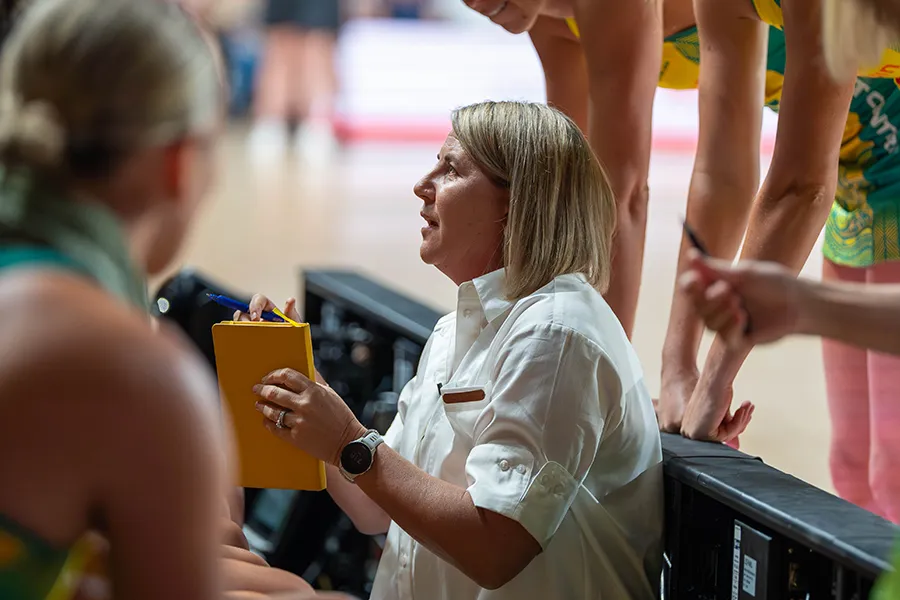
Marinkovich highlighted the importance of strong relationships within teams.
“You can have individual brilliance and strength, but a player's superpower only comes to life if it's complemented by the players around them.
“You can have star-studded lineups but until you can get the cohesion, you don't actually see the impact of what that brilliance can do.”
Reflecting on the selection process itself, Marinkovich said some of her proudest moments come when players who have previously missed out eventually earn national selection.
"The biggest part for me is that selection is not personal,” she said.
“While you're selecting and looking at players' performances it’s about what they will contribute to a bigger picture on the court.
“But it is personal in the fact that they're people first.
“To have conversations where you're making and breaking people's dreams the depth of emotions being felt doesn't go unrecognised.
"So to be able to have a conversation where it hasn't been overly positive as you’ve not named someone, but then to work with that player and empower them to take control of what their future can still be and then be able to recognise and congratulate them on what they've done to get that next selection is a privilege.
“It's a rollercoaster of emotions but it's one that is done with the utmost respect for who the person is as a human.”
Looking to the future, Marinkovich is excited by the development of Australia's next generation.
The Diamonds' coach is excited by the Australian athletes getting their chance to shine in SSN.
“There's a lot of our winning World Youth Cup side that have been in the line-ups of SSN teams this season and each of them have had very different experiences and court time,” she said.
“Hope White really showed particularly in that last game what she's capable of and the learnings that she's had across the season.
"Sophie Casey had a great injection into the game for the Thunderbirds in the Major Semi and is showing a real maturity in the way that she's playing within their system.
“Lily Graham comes out on court and has an incredible impact, and you see Liv Wilkinson do that as well then Ruth Aryang has showed the height of what her game can look like.
“There's some incredible talent including the likes of Grace Whyte, Kayla Graham and Charlotte Sexton as well.
“It's great to see particularly off the back of getting that World Youth Cup trophy that these players are being backed by the system.”
Marinkovich said patience remains critical when developing young talent.
"When we give our juniors an opportunity it might not be seamless straight away,” she said.
“But when you see their performances throughout the season and back them in with a little guidance you get rewarded for that belief.”