By Pip Turton
West Coast Fever defeated the Melbourne Mavericks 47–59 in a match defined by a brutal opening quarter, shifting momentum swings, and a Mavericks side that fought bravely but could never fully erase the damage done in the first fifteen minutes.
From the opening centre pass, Fever brought intensity, speed, and clinical execution.
The Mavericks, by contrast, were immediately under pressure.
Their timing was off, passing options were rushed, and errors began to creep into their game.
Fever capitalised relentlessly, turning turnovers into scoreboard pressure and forcing the Mavericks into early tactical timeouts as the game threatened to spiral.
The Cransberg sisters played as an unstoppable duo, and Romelda Aiken-George's positioning created a reliable target, allowing Fever to capitalise on every turnover.
Jessie Grenvold provided early resistance with intercepts and deflections, but it was not enough to stem the flow.
Fever’s movement through the midcourt was sharper, their timing into the circle edge cleaner, and their finishing more composed.
By quarter time, the margin had already blown out significantly in a 13-point difference.
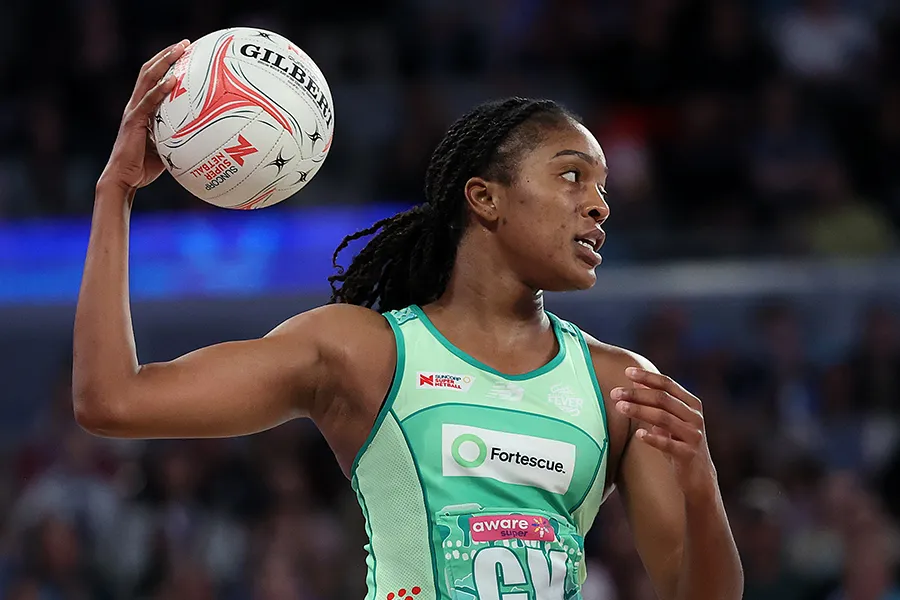
Zoe Cransberg rises high to claim possession in the air.
There was a clear response from the Mavericks after the break.
Jamie-Lee Price began to take control through the centre, lifting the tempo and stabilising possession.
Her influence became increasingly important as she connected defence to attack, delivering clean feeds into the circle and helping the Mavericks regain structure.
Sacha McDonald supported strongly through wing attack, providing safe hands and smart ball distribution, while Amy Parmenter and Kim Brown lifted the defensive pressure.
Their work slowed Fever’s flow and created turnover opportunities that the Mavericks began to convert.
Fran Williams was a constant presence, reading Mavericks’ feeds and shutting down space around the circle edge.
But in the shooting circle, Uneeq Palavi found moments of rhythm as she landed several important goals, including a couple super shots that helped swing momentum and bring the Mavericks back into the contest.
The Mavericks won the second quarter, signalling a shift in competitiveness.
Jamie- Lee Price and Shimona Nelson were in the hunt for the comeback.
The third quarter developed into a physical and contested battle.
Jessie Grenvold was again influential, reading Fever’s attack well and collecting intercepts that gave the Mavericks transition opportunities. Jamie-Lee Price continued to dominate possession, finishing with high involvement in feeds and goal assists, while keeping the attacking unit engaged.
Reilley Batcheldor and Palavi worked hard in the circle, but the Mavericks struggled to fully capitalise on their gains.
Turnovers at key moments disrupted momentum, and Fever’s defensive pressure forced rushed decisions.
Even when the Mavericks created scoring chances, they were often forced into difficult shots under pressure.
A key feature of Fever’s performance was their ability to maintain shooting efficiency under pressure.
Aiken-George remained reliable at the post, while Glasgow provided movement that pulled defenders out of position.
Despite this, the gap narrowed at times, and belief returned briefly.
The Mavericks showed resilience, lifting intensity and challenging Fever’s structure. But every surge was met with a composed response, and by the end of the third quarter, Fever still held a nine-goal buffer at 46–37.
Romelda Aiken-George was competitive throughout.
The final quarter became the most volatile period of the match.
Shimona Nelson’s introduction gave the Mavericks a strong finishing option, and her accuracy (20/22 overall) helped reduce the margin to five goals at one stage.
All the effort was there, the intensity was there, and for a moment, the comeback felt possible.
However, the key difference emerged in structure and decision-making under pressure.
Mavericks coach Gerard Murphy highlighted post-match that the super shot period broke down due to inconsistent execution of structured attacking systems, with players often becoming static instead of rotating, which reduced passing options and allowed Fever’s defence to apply heavy pressure and disrupt shooting rhythm.
In the end, Fever’s early dominance proved decisive. The Mavericks showed resilience, structure at times, and clear moments of quality.
The opening quarter created a gap that effort alone could not close.
It was a story of recovery versus control, and Fever’s control from the start ultimately defined the result, defeating the Melbourne Mavericks 47–59.