By Stephanie Smarrelli
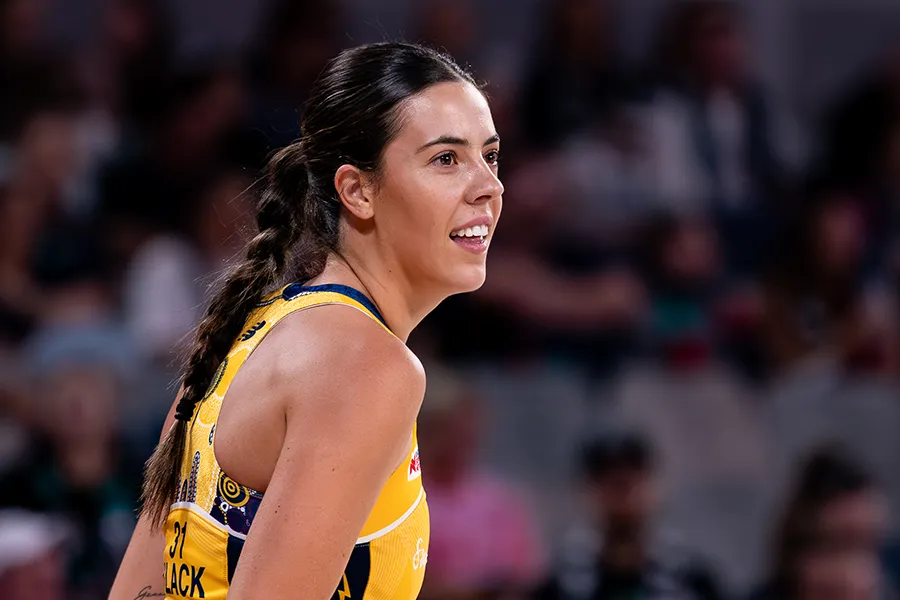
Long before an ACL injury put her on the sidelines last year, Ava Black was already learning how tough elite sport can be.
While recovering from the injury was undeniably difficult, Black believes something else was harder and ultimately more defining of who she is today.
Her time as training partner fighting for an opportunity that never felt guaranteed.
“ACLs, Achilles injuries, they’re such big long-term and loud injuries,” Black said.
“When you hear an athlete do one of those your jaw drops, your heart is at your feet, you're devastated for that person. It's so loud.
“You've got a massive support network, everyone reaches out to you and holds you through that time, then when you come back you have your first game and everyone's around you clapping and celebrating.
“That loud support you don’t get as a training partner.”
Without that same level of recognition, Black confessed that half the battle is simply continuing to show up.
“You're not getting a clap and no one's patting you on your shoulder because you're not injured,” she said.
“You're fully healthy but you're just not getting the opportunity, that's a hard space to be in.
Black found life as a training partner difficult.
“To consistently show up, not get all of those little check-ins, to be battling that and have a full-time job on the side while trying generate the same end result as everyone in the 10 it’s hard.”
Because so much of that work goes unseen, Black’s biggest advice for training partners is to give themselves credit.
“Half the time it's actually recognising the hard work,” she said.
“It's actually recognising that what they do every day to even just be there with this group, train and have their dreams still alive is a big achievement.”
The 22-year-old hopes club environments are all supportive of their training partners.
“At the end of the day, we don't have more spots for them right now so it is about how can we best support this group of talent and make them feel they are supported and we do see them,” she said.
“That's all I ever wanted as a training partner, recognition and the opportunity to at any point in time play with the team and be involved.
“I'd like to hope that a lot of clubs do that really well, that they really recognise and support their training partner groups which makes them feel like they want to turn up and be involved even if they don't get that pat on the shoulder.”
That period ultimately shaped Black’s mindset, the 22-year-old crediting her time as a training partner for building her resilience.
“Having a dream but not really seeing the end result, it didn’t feel realistic for me,” she said.
“But even now coming back from an ACL, I've realised and reminded myself that it's not easier now that you're capable again you still have to work hard and you've got to really push for court time and development.
"I'm still working really hard to be the same player as I was before and be better.
"The resilience piece never ends, it's going to keep going until I leave the game.
"I've realised going through rehab was bloody tough, but there's probably a lot of other things that are also bloody tough along the way and it's still bloody tough now.”
After months of rehab and reflection, casting her mind back to the moment she made her SSN return Black was raring to go.
“The first thing that came to my mind was about time,” she said.
"There was nothing else I could do to feel more prepared.
“At the nine-month mark, I felt I was ready to play, the excitement was bursting out of me.
Black couldn't wait to be back on the court.
"I just wanted to be released.”
While stoked be back on court, Black touched on how important it was to not let herself fall into a victim mentality during her time away.
“Your whole world is tipped upside down and there’s a lot of support for the first few weeks but then people move on,” she said.
“They’ve got to move on because there’s a game plan, a team and a championship to try and win still.
“That victim mentality comes from a place of feeling like you're the only one that's left behind to deal with everything and when you're in a team sport that's hard.
“You've got to front up for everybody else and try to remove that victim mentality.
"I wasn’t perfect during my rehab journey, but it was something I knew from the start I had to control.
“I wanted the coaches and players to always feel they could share good news, I wanted them to feel me encouraging them from the sidelines and feel I wasn't always in the pits which naturally I was at times."
During those tough times Black was able to lean on her friends who are some of her biggest supporters.
Black knew she had keep cheering her teammates on despite being on the sidelines.
She admitted all of her closest friends she’s met through sport and they’ve been by her side every step of the way.
"They didn't have to go through an ACL injury for me to feel like they knew exactly how I felt,” she said.
"That was the biggest bit for me, I had so many different people supporting me in my close friend group from all different angles.
"Roo [Reilley Batcheldor] had been through an ACL herself and was massive in showing me how to walk and navigate it.
“But then for Ash [Ervin] and Leesa [Mi Mi] they supported me as a person and still saw me and recognised my hard work to lift me up in different ways because they haven’t gone through the exact same injury.
“They all understand the job, they understand the world we live in and know exactly what to say and what kind of hangouts will lift me up.”
“It's been really special to have them by my side.”
Beyond friendships, Black’s love of reading has been another form of comfort.
The 22-year-old relating to another sporting star’s journey.
Black also enjoys reading and throughout her journey has used that as a way to switch off and be inspired.
“I'm obsessed with Mary Fowler's ‘Bloom’,” she said.
“I relate to her experiences and her philosophy on life very much.
“I've loved every bit about her journaling, the way she views sports and her morals outside of that.
“She's done an ACL herself, but I liked that she didn't touch on it too much and it was more so around what sport looked like when she was a bench player and how she navigated some really hard times in her life.
“I've definitely taken a lot of that into my own world, she’s so emotionally intelligent and the same age as me.”
While still early in her career, it’s clear the lessons Black has learned from the sport have never just been about life on the court but about everything that comes with it.
This article has been brought to you by Suncorp. Suncorp’s mission is to help more women and girls stay in sport, while encouraging more Australians to back them every step of the way. Because Suncorp knows this takes more than just the players. It takes a team.